

Vegan Ka'ak Sandwich
Ingredients
For the ka'ak
3.5 cups (700g) flour
1 cup (235ml) warm water
1/2 cup (120ml) warm non-dairy milk
2.5 tsp yeast
1 tsp baking soda
1 tbsp olive oil
For the filling
1 aubergine, cut into half circles
1/2 block vegan mozzarella, cut into triangles
Za'atar seasoning (see substitutions)
Sriracha sauce
Instructions
- Sift together flour, yeast, and baking soda. Add the water, soy milk, and olive oil, and knead to form a soft dough. Cover and let sit for at least an hour, or until the dough has doubled in size.
- Once the dough is ready, preheat the oven to 400F (200C). Cut the dough into however many rolls you want (I made four), and, using olive oiled hands, form into oblong rolls and place on a baking sheet. Sprinkle liberally with sesame seeds, then bake for 20 minutes or until golden brown.
- Place your aubergine circles on a separate baking sheet and douse in olive oil. Roast for 20 minutes, or until soft and brown.
- Once the bread and aubergines are ready, remove from the oven. Cut the bread in half and fill with cheese and aubergine. Season with za'atar and sriracha, then serve.
A longer and more detailed description
I see you over there, looking at my previous attempts at making bread and my agonised wailing at every failed attempt to get anywhere. I know how this looks and how ridiculous it is that, when confronted with the whole of Jordanian cuisine, I start giving the side eye to a bread. But look. I will never get any better at making bread if I don’t try, right? So why not fail to make yet another bread and abandon the idea of being a baker for another few months.
Except - spoiler alert - this one worked and is amazing, and that makes me very happy.
So let’s make an easy bread. Start by sifting together flour, yeast, and baking powder, then dumping in whatever liquids I listed above in the quantities I listed. If you get the quantities wrong, that’s okay. Add more water if you want a wetter dough or more flour if you want a drier one. Baking is simple like that. Cover your dough with a towel and wander off for a while, letting the yeast do whatever it is yeast does in there that makes dough fluff up and makes your entire home smell like bread. Truly baking is magical.
Once you come back from whatever it was you were doing - in my case, falling off a wall - heat your oven to 200C or its freedom units equivalent is. Chop your aubergine into half circles, then turn your attention back to your dough. Move your dough to a floured surface, then use your fists to roll it out a bit. Cut the dough into oblong rolls - my dough made four of these - then, after slathering your hands in olive oil, ball them up, then reshape them into roll shapes on a baking tray. Wash your hands or recruit your partner, then drench them in sesame seeds. Set them to bake for at least twenty minutes, or until you get bored and think they look done.
Meanwhile, add your aubergines to a baking sheet (it could be the same baking sheet, if you’re feeling spicy), drizzle them in olive oil, and set them to roast for the same 20 minutes. When both bread and aubergine are done, remove them from the oven. Slice open the bread and stuff it with cheese and aubergine. Add za’atar to your heart’s content, then add sriracha, then take a big bite and enjoy. !صحتين
Substitutions and suggestions
For the za’atar - You’re never going to believe this, but my local Woolworth’s does not sell za’atar, nor was I able to find a Middle Eastern grocery store in the middle of New Zealand. However, za’atar is easy to make on your own, and I highly recommend doing so, as it’s both a versatile seasoning on its own, and what really brings this sandwich together. To make your own za’atar, combine equal parts cumin, coriander, thyme, sesame seeds, and sumac. If you don’t have sumac available, you can substitute in lemon pepper or lemon zest.
For the aubergine - You don’t have to use aubergine. You can add whatever you want on your sandwich. It’s your sandwich, not mine. I’m just a website making suggestions, not your conscience.
For the Sriracha - You also don’t have to use Sriracha. These sandwiches are usually served with a chili sauce, but it’s up to you whether you want that, and if you do, what spice level you want.
What I changed to make it vegan
The bread itself uses lactic acid to fluff up. I tried to make this work by substituting in soy milk for regular milk, and while I think my bread is less fluffy, it’s still good. The sandwich itself is also generally served with baked eggs. I added aubergine after being inspired by the sabich, and because roasted aubergine is delicious.
What to listen to while you make this
I wasn’t expecting to find Jordanian prog-rock, but I did, and it’s excellent. I highly recommend vibing to El Morabba3 as you make a tasty sandwich.
A bit of context for this dish

I’m going to admit that I’ve done a controversial thing here. You see, much of Jordanian cuisine is similar to cuisine found throughout the Levant. It features olive oil, meats, and a variety of dishes served in a mezze. Dishes that are popular in Jordan are also popular across the Levant, and while it does have its own, unique dishes, these are meat-based stews that I didn’t have the courage to reproduce. Instead, I wanted to tell the story of ka’ak and why, despite it being found throughout the Middle East, it’s a valid choice to represent Jordan in this series.
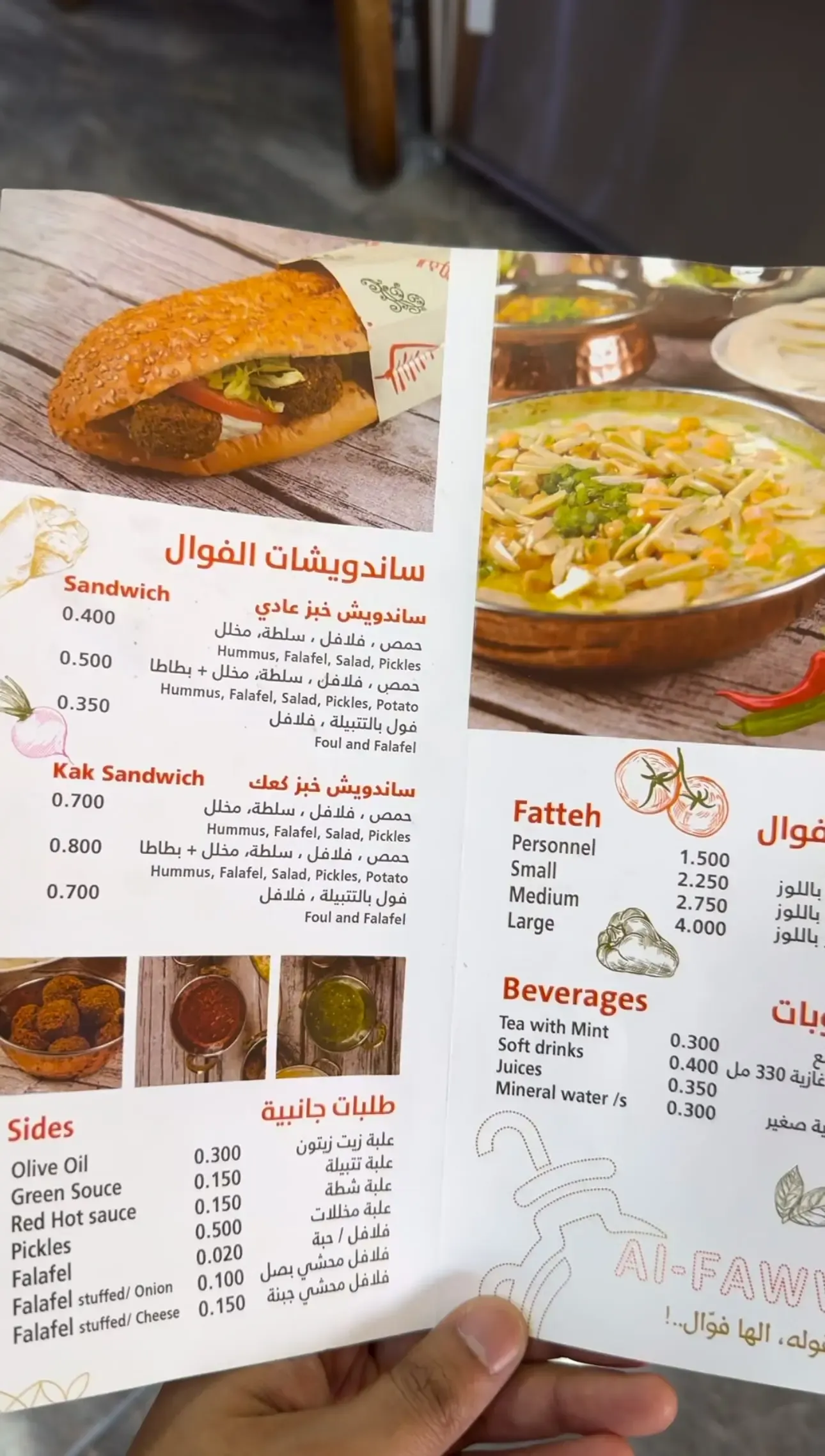 Menu from a Jordanian cafe (Source: Halalxplorer.com)
Ka’ak is, like many forms of bread, a very old dish. While the first mentions of it can be found in a 10th century Baghdadi cookbook, as I think has been made abundantly clear in this series, a dish being recorded is not the same as when a dish was invented. Bread is an ancient food, and the idea of sprinkling bread with sesame seeds, then shoving things into it is also likely older than the 10th century.
Ka’ak continues to be found throughout the region, though its arguably most famous variant is the Palestinian variant, ka’ak al-quds, or Jerusalem bagel. This version, like many versions, is oblong with a hole in the middle rather than as a sandwich. Ka’ak being served as a sandwich is unique to Jordan, even if the bread that lies at the sandwich’s heart is not itself unique.
It’s this idea that something shared among diverse people, with as many variations as there are people to tell its story, that I find most interesting about ka’ak. You can find versions baked and stuffed with dates, shaped into bagels, shaped into rectangular bagels, and stuffed with any variety of ingredients, but all of it falls under the same grand umbrella and community. Ka’ak remains ka’ak throughout the Middle East, throughout the history of migration and the blending of peoples. Ka’ak takes on new character and new form while never losing sight of what made it special in the first place.
This sandwich is simple, but that simplicity belies a deeper truth about the Middle East and the people in it. For all the differences, for all the unique and wonderful variations, there is still an umbrella arcing over it all, a shared commonality that is worth celebrating.
In the case of ka’ak, it’s delicious.