

Vegan Baleada
Ingredients
1 can refried beans
1 package firm tofu
1 avocado
1 tomato, chopped
1 tbsp black salt
1 tbsp nutritional yeast
1 tbsp harissa
1 tsp turmeric
Salt
Pepper
Tortillas
Instructions
- Heat refried beans in a pot over medium low heat. Stir in chopped tomatoes. Keep warm, but stir frequently to keep from burning.
- Heat oil in a pan over medium heat. Crumble tofu into the pan.
- Add in the spices and mix to thoroughly coat. Cook until fully cooked (~5 minutes).
- Warm tortillas by placing them in the oven at 160C (340F) for one minute.
- Spread refried beans over each tortilla. Add slices of avocado and a generous helping of scrambled tofu. Fold in half and serve.
A longer and more detailed description
I will be honest - this is not a complicated recipe. This is a simple breakfast taco in its purest form, and I love it.
Start by scrambling some tofu. I’ve included a recipe for a scrambled tofu that works for me, but feel free to make whatever scrambled tofu brings you joy. The point is not the exact recipe. The point is that you have a tofu scramble.
While your tofu is scrambling, heat up refried beans. This is easy. I believe in you. Mix in tomatoes if you feel fancy, don’t if you don’t. Slice an avocado and warm up tortillas while you’re here. The tofu scramble is the longest wait.
Once your tofu is ready, spread your beans on a tortilla, stack it with avocado, tofu, and maybe a sprinkle of cheese if you’d like, and serve. ¡Buen provecho!
Substitutions and suggestions
For the tortillas - Buy the small tortillas. You can also try making your own, but I did not, because I am lazy. I also recommend getting flour tortillas rather than corn tortillas because store-bought corn tortillas are universally terrible. Fite me.
For the tofu scramble - Feel free to make your own version or sub this out entirely. It is your baleada, after all.
For the refried beans - The beans are key to this dish, so I recommend not buying the terrible brand I found at the store. They were labelled as “bean paste,” for the record. It was not good.
What I changed to make it vegan
Baleadas are a very flexible food, which is unsurprising, given they are a street food icon. I stuck with a simple iteration, swapped out eggs for tofu to make it more of a breakfast feel, and used vegan cheese rather than actual cheese.
What to listen to while you make this
The song says “Banana.” I enjoy banana. I am not a sophisticated woman.
A bit more context for this dish
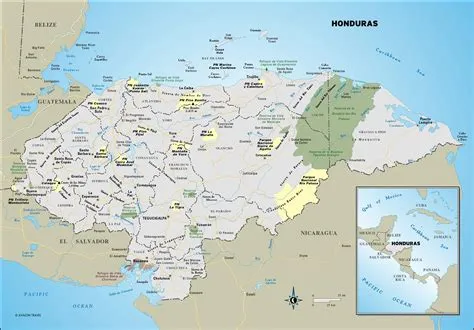
Honduran cuisine, like much of Central American cuisine, is a blend of influences, primarily those of Indigenous Mesoamericans and Spanish. It features corn, stews, tropical fruit native to the area (especially coconut), and lots of seafood.
And of course, baleadas.
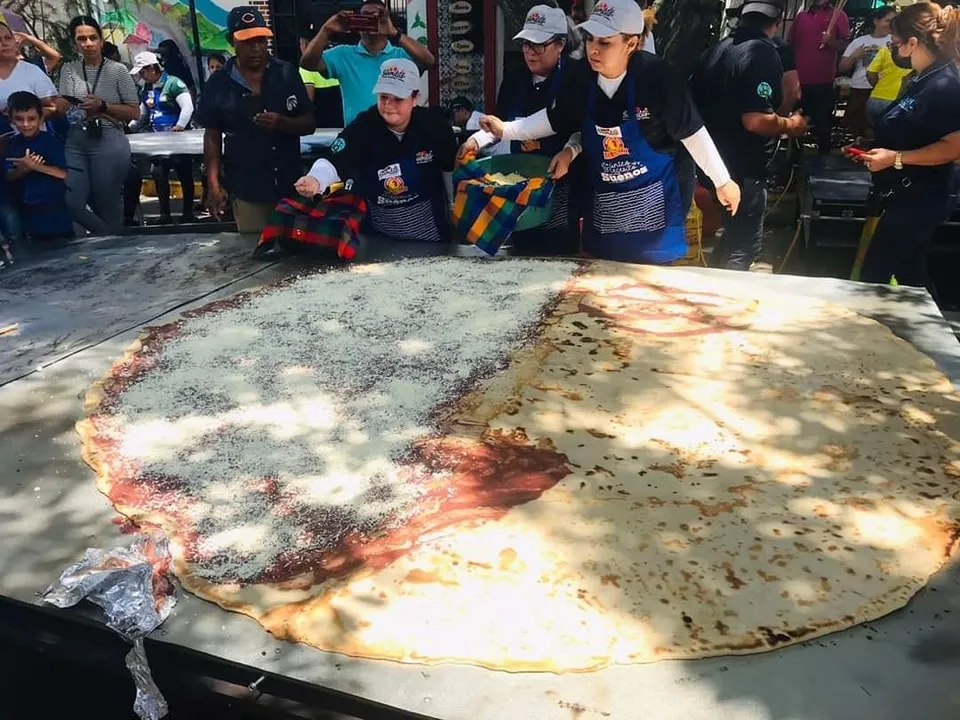 A 2.5m baleada being prepared in San Pedro Sula in 2023 for National Baleada Day (Source: Honduras.com)
Baleadas are a staple of Honduran cuisine. An iconic dish sold as a street food, they’re simple and easy to make, yet filling. It’s exactly what you want out of both a breakfast and a street food. They’re flexible and delicious.
Of course, looking at baleadas, there’s an obvious comparison to be made, especially if you’re from Texas and familiar with a certain war between Austin and San Antonio. Baleadas, especially as they’re traditionally made, look a lot like the breakfast tacos that can be found at a place like Tacodeli. They look and taste a lot like the tacos I’d get for my friends to show them what they were missing from not living in Texas. Making these was a deeply familiar experience, even though I’ve never been to Honduras.
And though I know drawing a comparison between a symbol of Honduras and Tacodeli is a potentially insulting comparison to draw, I think it’s worth looking at the origins of both baleadas and Tex-mex breakfast tacos in a little more detail. There’s a common origin there, and it’s well worth exploring.
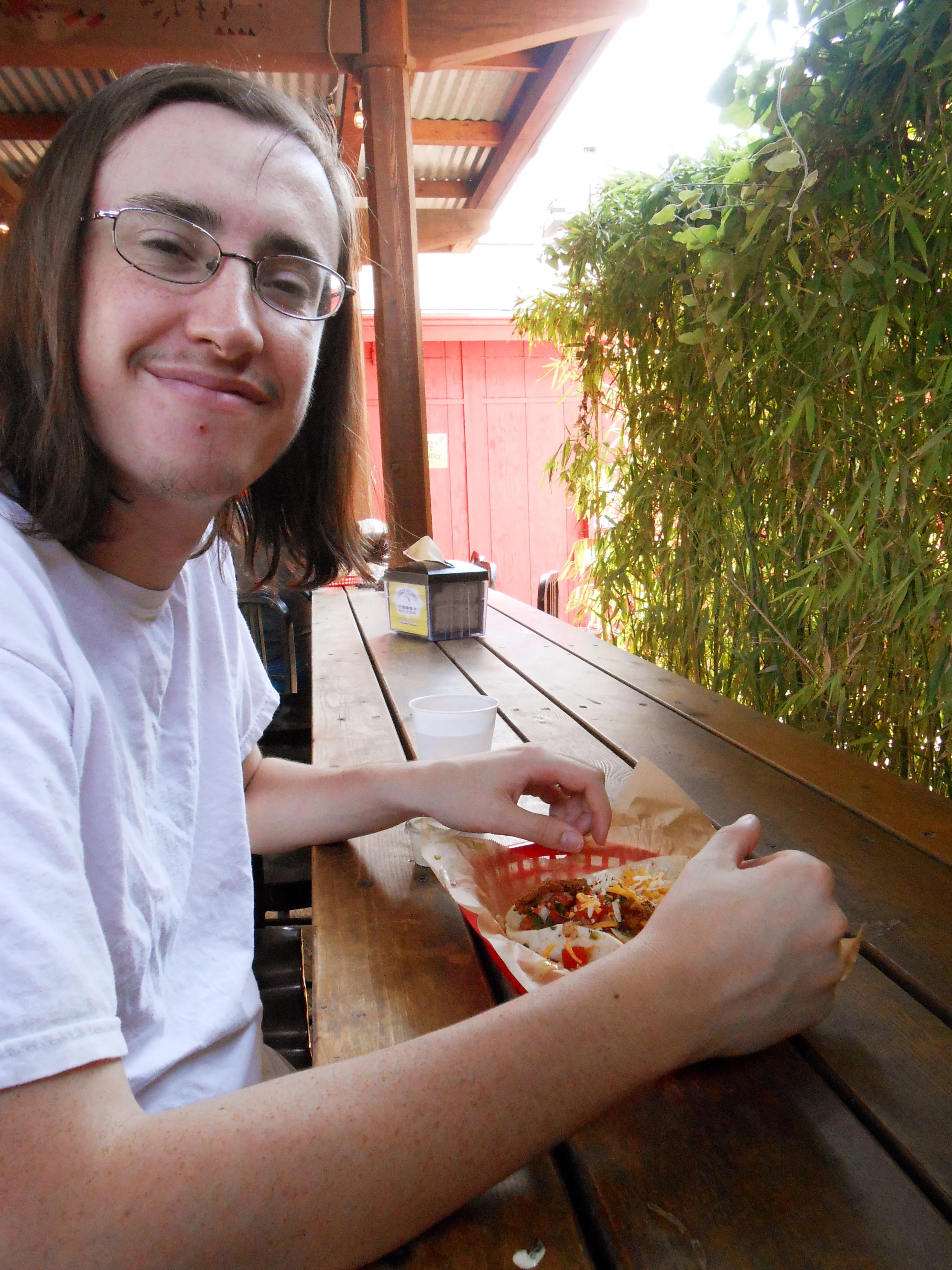 The author's partner eating tacos at Torchy's Tacos in Austin, TX (don't look at me like that, i know tacodeli is better too)
The history of tacos is a murky one. While the idea of a tortilla covered in things and folded seems like it would fit in with our understanding of Mesoamerican diets, it’s more likely that the taco, like many other portable dishes, is a product of necessity that evolved after the arrival of the Spanish to Central American. Historian Jeffrey Pilcher, for instance, theorises that the taco originates in 18th century Mexican silver mines, with the word “taco” deriving from the charges used to excavate the ore. On the other hand, there is archaeological evidence suggesting tortillas have been eaten in Central America for at least 5000 years, and the concept of wrapping food in a tortilla isn’t exactly a novel one.
Part of the question of the origin of the taco is the question of what a “taco” is in the first place. Is anything wrapped in a tortilla a taco? How does that account for rotis or wraps? Does it need to be from Central America? Again, we run into the question of the hard-shell versus soft-shell taco and who can lay claim to inventing a dish in the first place. Pilcher would again argue that even American versions of the taco were still invented by the Mexican-American community, though that then begs the question of who gets to lay claim to a dish.
All of this is to say that the question of the origin of a dish is more complex one than just tracing a recipe. There is a hazy border between “taco” and “not-taco,” as there is with most foods. If, however, we take that idea that what we consider a modern taco originated in the silver mines of Mexico, then it’s worth considering how that impacts the origin story of the baleada.
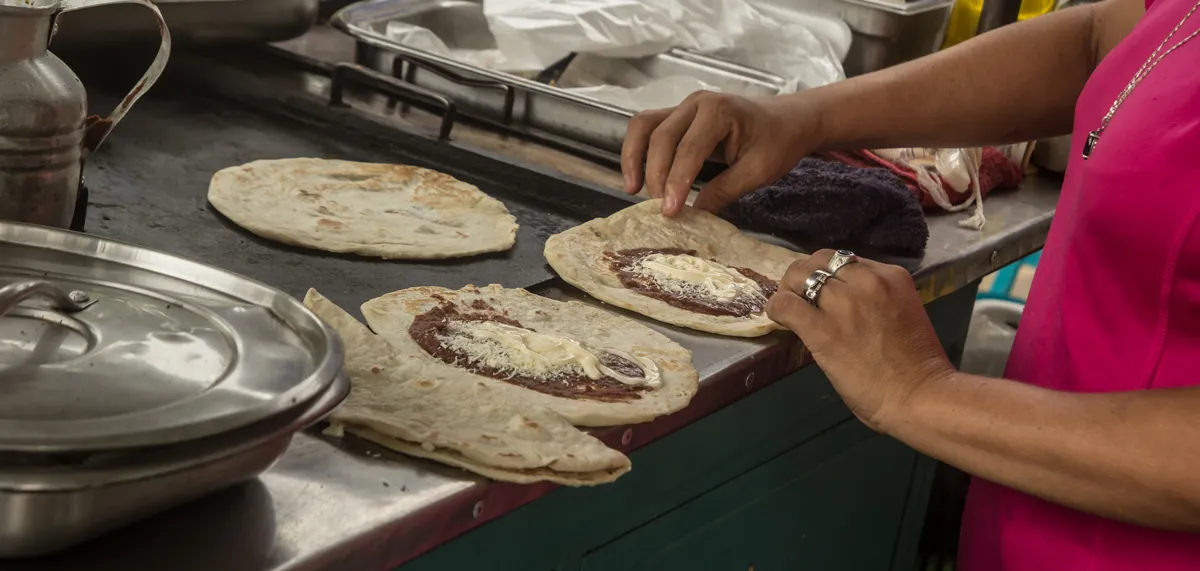 A woman making baleadas (Source: Amigofoods.com)
There are conflicting stories about the origin of baleadas. One origin story places the creation of baleadas in the hands of the Lenca people, an Indigenous group native to southern Honduras. The Lenca, this origin story argues, have been making flatbread and beans since time immemorial, making the baleada an indelible part of the Indigenous heritage of Honduras.
This, again, calls attention to the problem of the taco. Just because a dish is theoretically possible doesn’t mean the people it’s attributed to were making it. On a purely linguistic level, the word “baleada” deriving from Lencan doesn’t work - Lencan was likely part of the Macro-Chibchan language family, which did not use consonant-vowel pairings like those found in the word “baleada.” However, it could also be argued that “baleada” is a modern name attributed to an ancient practice, though it’s here that we go back to the archaeological problem. Mesoamerican peoples have absolutely been making tortillas and related flatbreads for millennia. Where baleadas fall on the spectrum of what has been made determines whether it originated with the Lenca.
Regardless, however, much like with the rest of Honduras, baleadas are now very much part of the Lenca diet. Whether they started there, I do not know, but they have become part of the living story of Indigenous Hondurans.
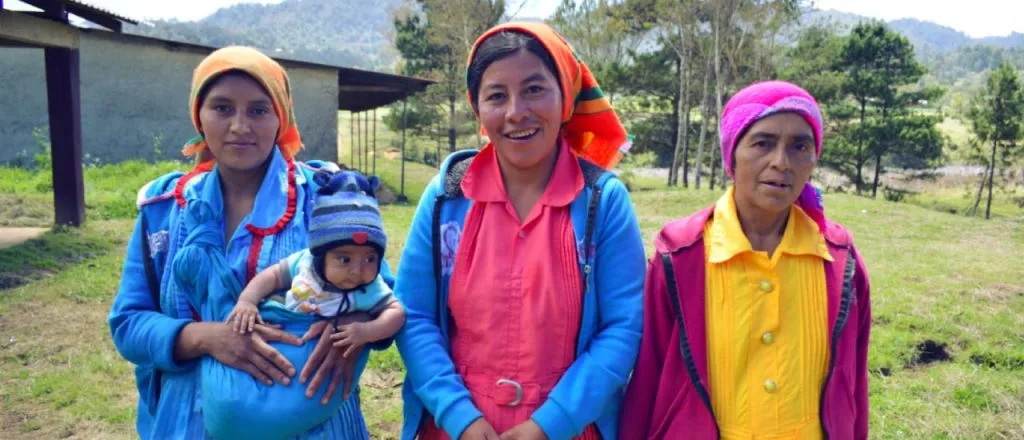 Lencan women in Honduras (Source: Tunota.com)
A second origin for baleadas places their origin in the northern coastal town of La Ceiba. Here, a woman started making and selling baleadas for dockworkers looking for a quick snack. As she stood there, selling them from her cart, she was shot by bank robbers. In her honour, the patrons of her stand started calling them “baleadas” - “shot.”
This story, like similar stories of aptly named dishes, feels a little too good to be true. In the dishes that are clearly named after a person or event, the origins are clearer and easier to trace back to whatever word or name they derive from. People want their names to be specific, after all, especially when memorialising a particular event. That there are also no details I could find about this shooting makes this seem unlikely to be the origin of the name.
This doesn’t mean baleadas didn’t make their entrance into Honduran cuisine via dockworkers. As we’ve seen with other dishes, foods can lie underground for centuries before becoming part of the national identity. However, I think it’s worth considering a third origin for baleadas, and that involves going back to the taco.
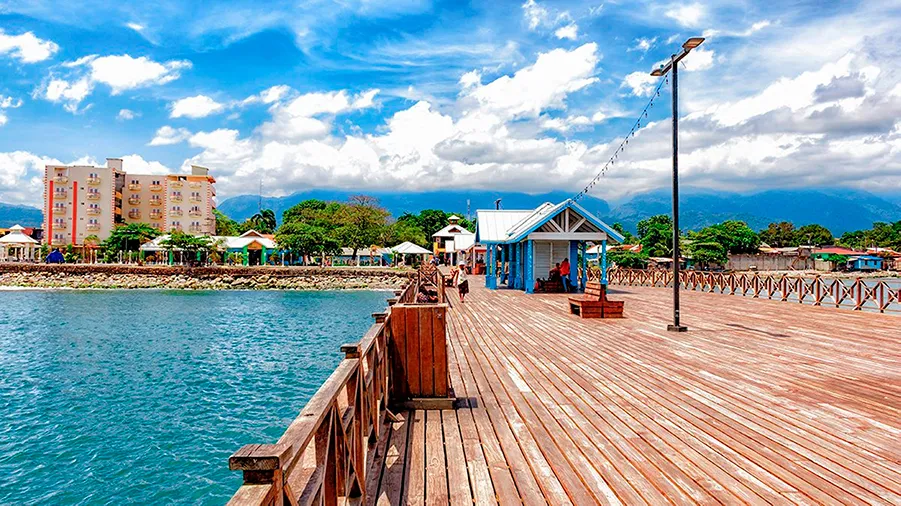 La Ceiba, Honduras (Source: Laprensa.hn)
Much like in Mexico, silver mining represented a large part of the colonial Honduran economy. Conditions in Honduran mines were similar to Mexican mines, with workers labouring for long days in the heat and darkness of a mine. Honduran workers, like their Mexican counterparts, needed food. Many of these silver mines were located in Lencan territories, where the Lenca still lived and practiced their traditional ways of life. Throughout Central America, Indigenous cuisine became intermingled with colonial cuisine to create something new. It seems entirely possible that the same process that created the taco in Mexico created the baleada in Honduras.
The names even suggest this might be the case. If “taco” is named after an explosive, and “baleada” means “shot,” the names seem similar enough in their suggestions of explosions.
After Honduras gained its independence from Mexico and workers returned to new jobs across the rest of Honduras, baleadas may have travelled with them.
To a stand in La Ceiba where they gained immediate popularity and became part of the fundamental identity of Honduras.
It’s a nice story. I can’t prove it, but it’s a story that brings all the stories together into one. It tells the story of Honduras, makes the baleada part of everyone’s narrative, and fits the linguistic and migratory patterns of the people of Honduras.
There’s something fantastic about the splashy legends. There’s also something wonderful about stories that incorporate a grander narrative of the origin of food.
Also, this origin of baleadas and tacos deep in the silver mines of Central America solves the breakfast taco question that’s haunted me since I first moved to Texas. Austin isn’t the origin of the breakfast taco. It was born in Central America and just called “breakfast.”
Or, in the case of Honduras, “baleada.”